The City Palace of Udaipur is the city’s most precious gem, offering a deep insight into the history of Rajasthan.
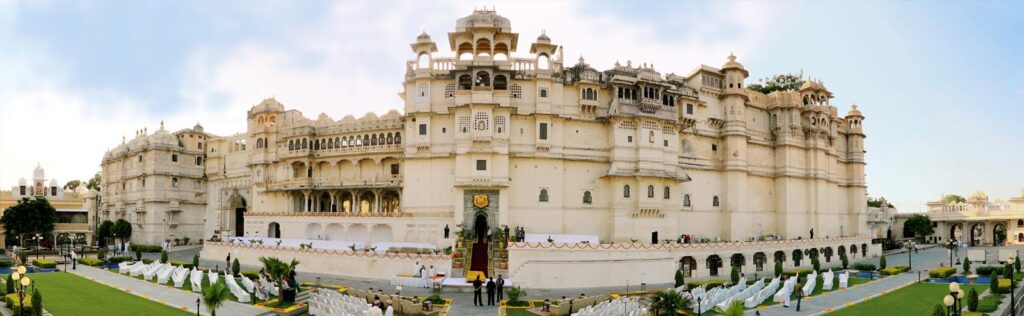
The City Palace of Udaipur is the city’s most prized gem, offering a deep insight into the history of Rajasthan. It houses an unparalleled collection of artifacts from both the medieval and European eras. A visit here also affords magnificent views of the shimmering Lake Pichola—one of Rajasthan’s largest, oldest, and most beautiful lakes. Showcasing architectural artistry that was unsurpassed in its time, this majestic palace is a must-visit destination in Udaipur.
History
The City Palace of Udaipur is actually a complex of palaces, with construction beginning in 1559 AD. Situated on the banks of Lake Pichola, it offers magnificent views of the city, the Lake Palace (also known as Jag Niwas), and Jag Mandir. Maharana Udai Singh of the Sisodia dynasty initiated the construction of the City Palace shortly after founding the city of Udaipur. Although various builders expanded the complex and added new structures over the years, the architectural style of the entire complex has remained consistent.
Architecture
The City Palace complex features several gateways, including Hati Pol (Elephant Gate), which serves as the entrance to the palace, and Bari Pol (Big Gate), which leads to the Tripolia (Triple Gate). The palace grounds contain courtyards, towers, and balconies, some of which served specific purposes. For instance, the Suraj Gokhada (Sun Balcony) was where the Maharana would appear before the public during times of crisis to boost morale. Another highlight is Mor Chowk (Peacock Courtyard), featuring a wall inlaid with a mosaic of a peacock made from blue glass. Meanwhile, Surya Chopar (Sun Courtyard) is distinguished by a massive, decorative sun emblem.
Within the complex, Krishna Vilas houses an extensive collection of paintings depicting various scenes and moods from the lives of the Maharanas, such as royal processions, festivals, and competitive games. Manak Mahal (Ruby Palace) showcases exquisite glass and mirror work. Additionally, Moti Mahal (Pearl Palace) features fine mirror ornamentation; Chini Mahal is adorned with lavish tilework; Bari Mahal centers around a garden; and the Zenana Mahal (women’s quarters) houses a collection of fine paintings.
The Amar Vilas features beautiful hanging gardens complete with fountains, towers, and terraces. Both the Shiv Niwas Palace and the Fateh Prakash Palace have been converted into luxury hotels; the latter is home to the renowned Crystal Gallery, which houses a collection of exquisite Osler crystal pieces.
The City Palace complex also houses the Pratap Government Museum, a treasure trove for understanding the history of Mewar, featuring exhibits of ancient sculptures and inscriptions. The museum also displays ancient Mewar paintings and a turban that once belonged to Prince Khurram—who would later become Emperor Shah Jahan.